Tramontina makes some of the world's finest cookware — and a website that gave Indian buyers no reason to believe it. We rebuilt the experience to educate before it sells, across four product ranges and two material-science stories.


Client
Tramontina India
Premium cookware, since 1911
Scope
4 product ranges, PDP system,
Material Science & Care pages
Deliverables
Research · IA · UX/UI ·
Design system · Build
Project Overview
A scalable digital experience designed to educate customers about cookware materials while helping them confidently choose the right product.
The brief
Tramontina is a globally recognised premium cookware house — four generations of family ownership, sold in 120+ countries. In India, that reputation lived almost entirely offline. The objective: a scalable digital experience that showcases its flagship ranges while helping customers understand why a material matters before they buy.
Deliverables
UX Research
Information Architecture
UI/UX Design
Responsive Design
Shopify Development
Mobile First Design
CMS Integration
Design System
What we built
A unified system across four ranges — Titanex, Bestow, Fusão and Velo — anchored by two cross-cutting education pages, Material Science and Care & Cleaning. Customers can understand a material, compare ranges, and make an informed decision inside a single, CMS-driven experience the brand team can extend without a developer.
Engagement
8-week design and build engagement, structured in four phases — Strategy, Research, Ideation, Design — feeding a CMS architecture built to roll the same template across the full catalogue.

Problems to Solve
Business Challenges
Weak Brand Differentiation
Failed to communicate 115+ years of heritage, material expertise, and premium craftsmanship.
Poor Product Discovery
No clear segmentation, filtering, or collection-based navigation.
Low Brand Trust
Missing certifications, testimonials, manufacturing story, and trust signals.
Limited Product Education
No dedicated experience explaining materials, health benefits, or cookware technologies.
Scalability Issues
Lacked a Shopify CMS structure for efficient content and product management.
User Challenges
Why Tramontina?
Users couldn't understand why Tramontina was better than competing cookware brands.
Which Product Fits Me?
No easy way to compare cookware collections based on materials or use cases.
Can I Trust This?
Missing social proof, certifications, and authority signals reduced purchase confidence.
What Makes This Material Better?
Technical materials lacked simple explanations and real-world benefits.
How Do I Maintain It?
No guidance on care, cleaning, storage, or product longevity.
MOODBOARDING
Our designers went beyond the usual design clichés for meditation apps. To achieve a more realistic and high-end aesthetic, the moodboard blended urban settings with muted colors and rich textures.



THE PROCESS
Project timeline - 8 Week
1.
STRATEGY
Goals and approach + Roadmap + Opportunites
2.
RESEARCH
Pain Points + Insights + User Personas + Competitor Analysis + User Journey
3.
IDEATE
Architecture + User Flows and cases + Low Fi Sketches and Wireframes + Brand Tone + Functionalities + Mood Board
4.
DESIGN
High Fidelity + Design System + Brand Identity + Visualization + Clickable Prototypes + Customisation Module
UX research Process
Extensive research was conducted to understand the target audience's preferences, pain points, and motivations
USER PERSONA
We conducted user research to identify 7-8 distinct user personas. This allows us to tailor the website experience for each unique audience segment.

The Health-Conscious Home Cook
Age:
28–40 Years
Profile:
A working professional or homemaker who cooks daily and prefers cookware that is safe, durable, and easy to maintain.
Goals
Buy non-toxic cookware for the family.
Understand material differences before purchasing.
Invest in long-lasting cookware.
Pain Points
Doesn't know the difference between Cast Iron, Triply, Ceramic, and Enamel.
Finds cookware specifications confusing.
Unsure which cookware suits everyday cooking.
Needs
Material comparison.
Health benefits.
Care & cleaning guidance.
Easy-to-understand product recommendations.
Buying Decision Factors
Health & Safety
Ease of Cleaning
Durability
Brand Trust
Product Reviews

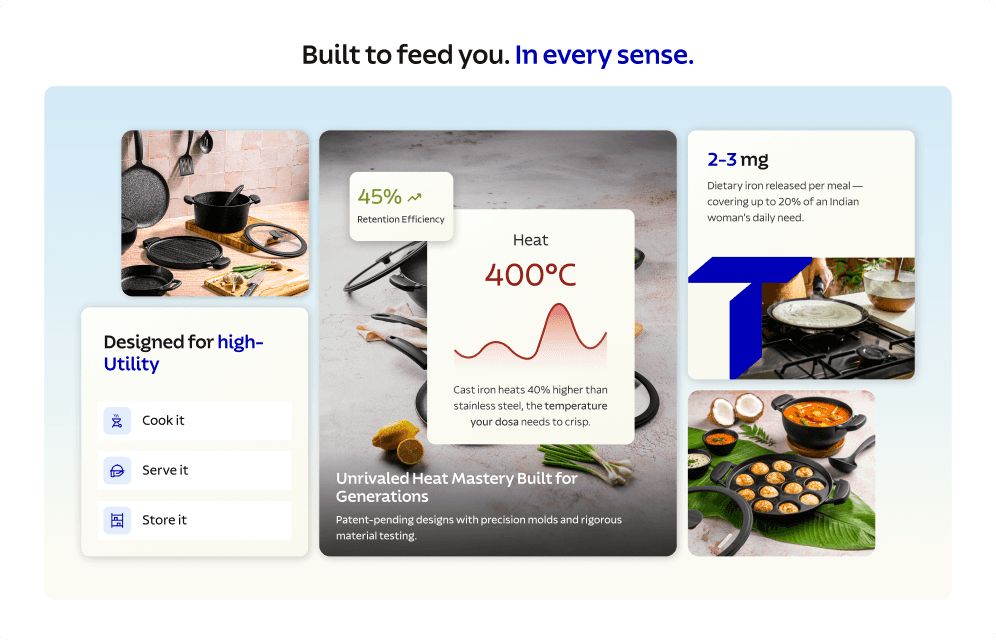
Titanex by Tramontina — Trusted Worldwide Since 1911
INDIA’S 1st smooth stone finish cast iron
Shop Titanex Range
Information Architecture
Reorganized the website into a clear, scalable information hierarchy that simplifies product discovery, material education, and purchase decisions.
Reorganized the website into a clear, scalable information hierarchy that simplifies product discovery, material education, and purchase decisions.
1.
Improve Discoverability
Organized products into clear collections with intuitive navigation and filtering.
2.
Educate Before Purchase
Introduced dedicated Material Science and Care & Cleaning pages to simplify complex information.
3.
Simplify Navigation
Created a consistent hierarchy across all product experiences for faster exploration.
4.
Build for Scale
Created a consistent hierarchy across all product experiences for faster exploration.

User Journey
Mapped the end-to-end customer journey to identify decision barriers, reduce friction, and create a seamless path from product discovery to purchase.
Discover
Help users easily find the right cookware collection.
Learn
Educate users about materials, health benefits, and product features.
Evaluate
Enable comparisons through specifications, certifications, and social proof.
Purchase
Create a frictionless path to checkout with confidence.
HOW WE SOLVED THE PROBLEMS
Each screen is annotated to the element doing the work — and read through the two lenses a product designer has to hold at once: the user's doubt it removes, and the business outcome it's built to drive. This single template carries all four ranges.
Open with the product in motion — and one thing to do next.
PROBLEM
A first-time visitor formed no impression of quality and had no obvious next step — so the most expensive traffic bounced before it ever engaged.
SOLUTION
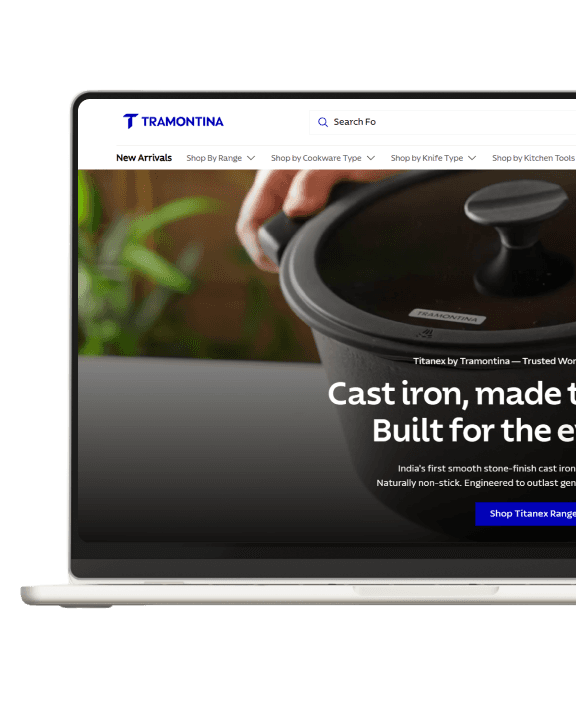
A full-bleed lifestyle video — seasoned iron searing in real use — with one positioning line ("Cast iron, made the old way. Built for the everyday") and a single CTA.


We stopped selling cookware. We started selling the meal.
PROBLEM
SKU names like "26cm Pre-Seasoned Pan" forced buyers to decode specs, and "You are saving Rs.791" trained them to wait for discounts — killing premium feel and stalling discovery.
SOLUTION
Rebuilt cards around intent — the dish as headline, value over discount, "Add" → "Bring it Home." Users find their pan by recognising their cooking; the brand competes on how good, not how cheap.
Make the proof scannable
PROBLEM
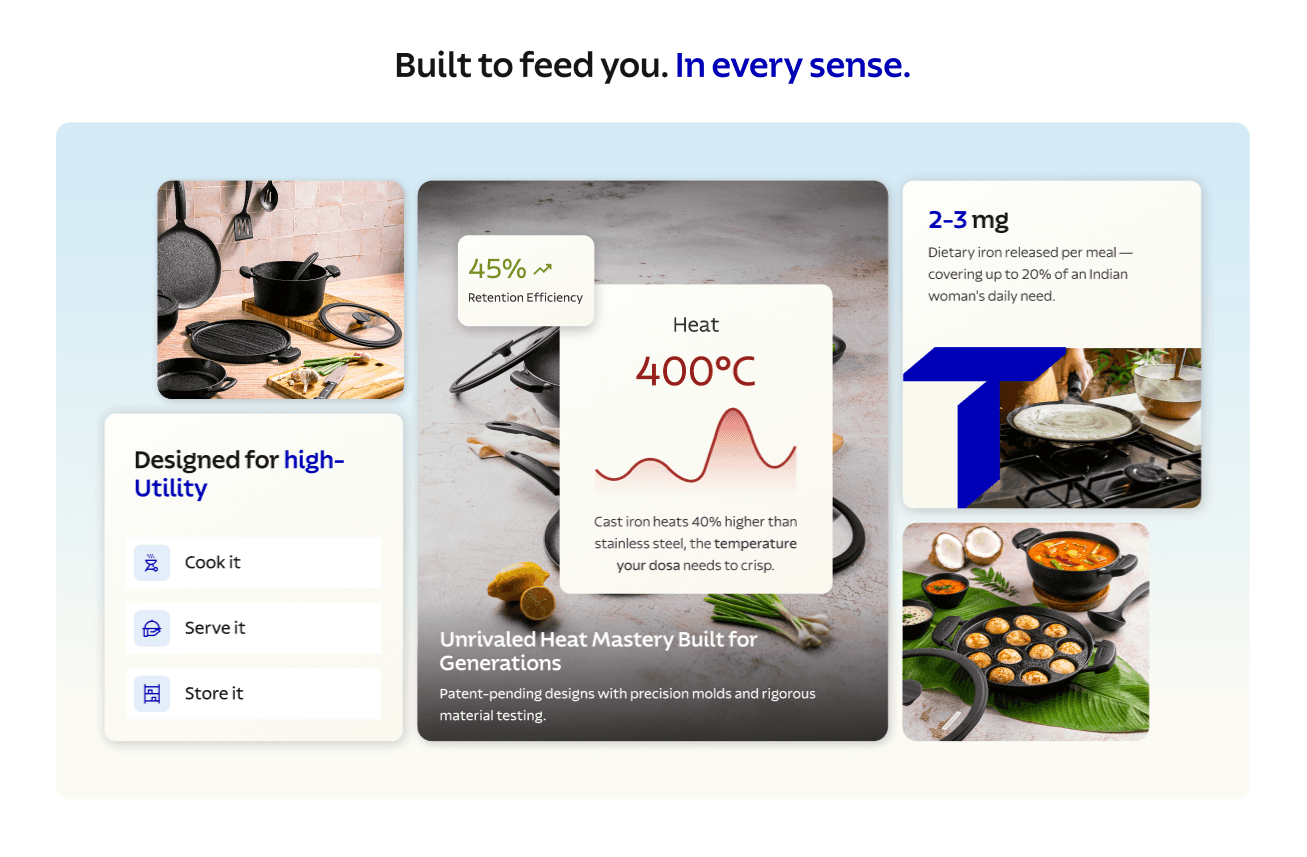
The product's best arguments — heat retention, iron release, durability — were buried in flat spec lists nobody reads. The evidence existed; the hierarchy didn't.
SOLUTION
A bento grid that surfaces the three or four claims that actually move a decision, each tied to a cooking benefit and weighted visually by importance.

Teach the material before asking for the sale.
PROBLEM
Nothing explained why this material outperforms a regular pan. A user weighing cast iron against ceramic had no neutral place to understand the trade-off — so the decision moved to Google, then to a competitor.
SOLUTION
A numbered anatomy walkthrough on the page, feeding a dedicated Material Science deep-dive that treats every range with equal depth.
Turn 115 years into a reason — not a footnote.
PROBLEM
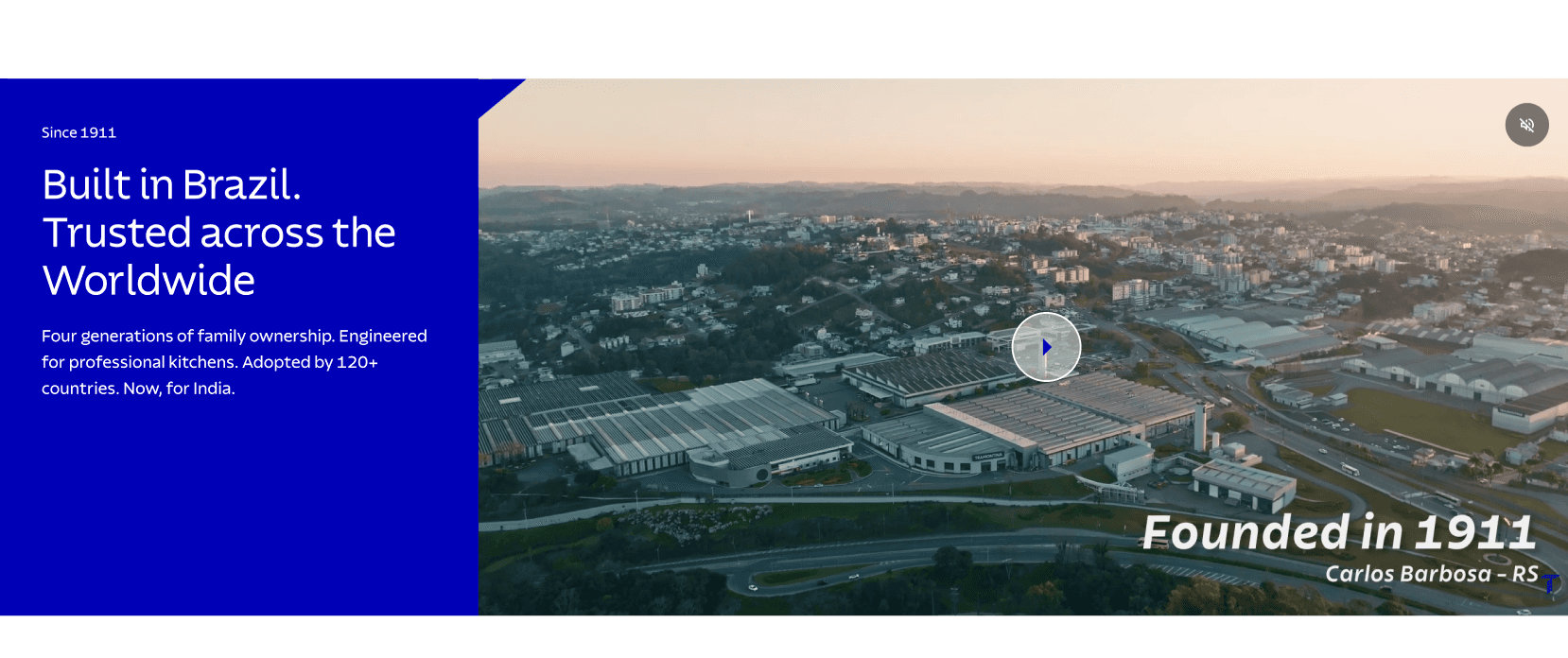
Tramontina's strongest differentiator — a century of manufacturing, exports to 120+ countries, its own foundry — was invisible. Without it, the brand read as commodity, and premium pricing had nothing to stand on.
SOLUTION
A "Built in Brazil since 1911" legacy band with real foundry footage and provenance — delivered through a consistent brand system (the T-mark, the blue, the type) applied across every range.

Show the making to earn the trust.
PROBLEM
Claims of quality without evidence read as marketing. The funnel proved it — interested users reaching the cart but not buying, unconvinced the product was worth the price.
SOLUTION
An "Art of Crafting" strip showing the real process — foundry, finishing, and robotic testing — turning quality from a claim into something the buyer can see.